

Notes on Building a 24+ Agent System to Hold My Multipassionate Life
The Fountainhead, Part 1 — what a non-developer built on a Mac Mini in Boulder

Sunday night. The light is still out as spring dances its way into summer. The TV is on. I am not watching it. I am staring through it, thinking about what Monday will bring.
Anxiety electrocutes me as an intrusive thought jolts me toward my phone. Do I have calls tomorrow? I open Outlook on my phone and look at my calendar. Calls start at 8am and don’t stop until 2pm.
Mother of God. WHY? HOW?
A sigh accompanies that feeling of dread permeating through my body.
I want to cry and tantrum, but instead I just lay there on the couch, staring at the wall, breathing.
Now, look. I have the coolest boss on the planet. And I get to do interesting work.
But I can’t ever seem to reconcile with answering to people, or with being forced to work inside structures I don’t necessarily agree with. Playing the game to survive inside the circus that is corporate life is amusing at times, but mostly exhausting.
I don’t do fake well.
I don’t want to live a life that doesn’t feel authentic.
I want freedom. I want to answer to myself. I don’t want to manage people or be managed.
I want life to feel good and free.
I don’t want to fit inside this futuristic industrial revolution system that awards compliance and clown-like hierarchy. And I don’t want to waste my time trying to change a system that isn’t ready to be moved.
I want to create my own system.
And that is just what I am doing.
For years and years I have been obsessed with online business. I admittedly even took some of those digital marketing pyramid scheme courses, just because I thought it was so cool. I tried a few different things but always gave up when I got too overwhelmed, or when the day job became too much.
Here is an example of one of my earlier attempts for your enjoyment: an attempt at run influencing. Woof.
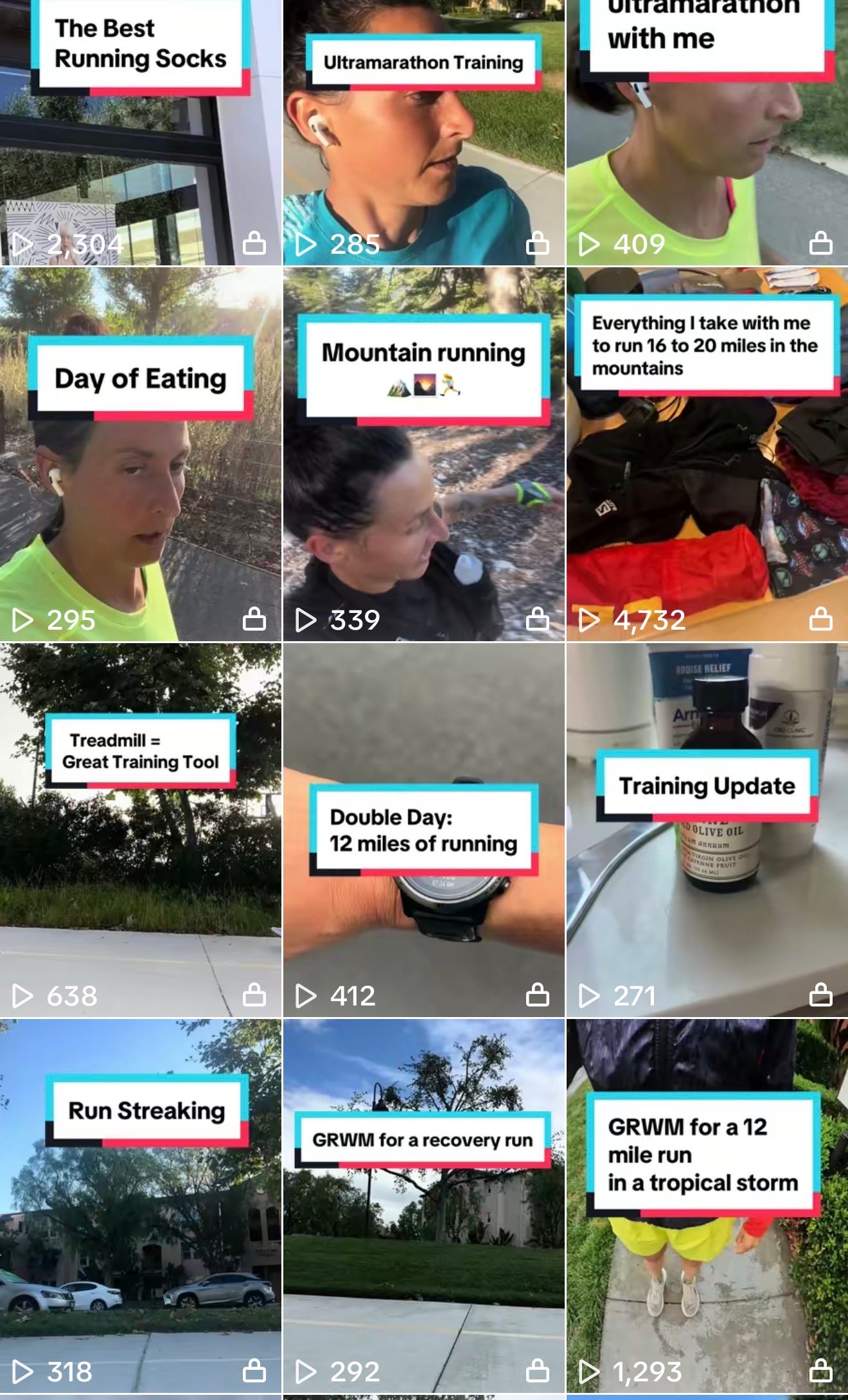
I really could have used AI back then, but looking back, I gave up because what I was trying to build wasn’t authentically me. I was still trying to fit the mold, just online.
Which is ironic, because I have never been one to fit a mold. I blame my horoscope often — I am an Aquarius sun and moon. According to the stars, I am supposed to march to the beat of my own drum and be an alien-like rebel. I am not much for crowds, or for what other people are doing, and I find that I really just see life differently.
(Actually Substack is the first time I have felt like there are other people like me, but I digress.)
I always like to go my own way, even inside a system that tries to prevent it.
A few months ago, I had a thought.
What if I took the vision I keep trying to apply to corporate systems — the org charts, the workflows, the architectures I can see clearly but can’t get adopted because of governance or security or someone else’s roadmap or no one understanding AI — and applied it to myself instead. What if I stopped trying to make my brain fit into someone else’s structure and built my own? What if I actually invested in me, and took this multipassionate brain with too many ideas and not enough hours, and plugged it into an autonomous system that could help me scale?
What if I took these 11 different online business ideas I have gathered over the years and plugged them into one system?
What if I don’t have to pick one thing? What if I don’t want to pick one thing? What if my ikigai — the Japanese concept for the reason you get out of bed, the intersection of what you love, what you are good at, what the world needs, and what you can be paid for — isn’t singular?
What if mine contains multitudes? What if I am not supposed to narrow it down?
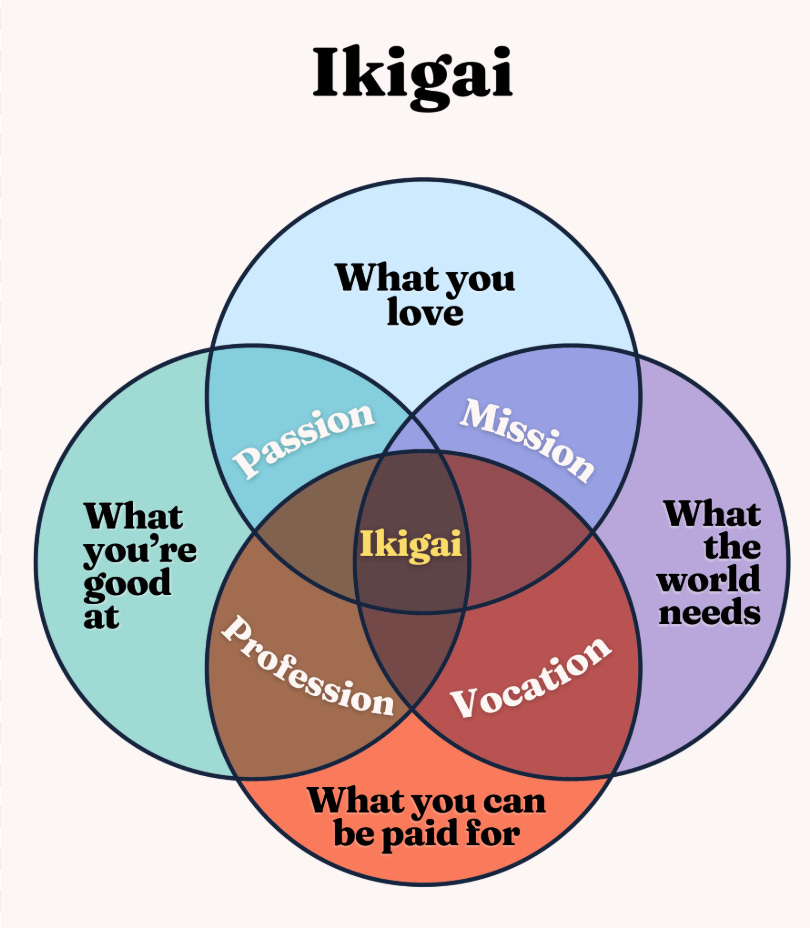
What if AI is the vector that finally lets me stop narrowing and start being?
That is the question underneath all of this.
How much can a system hold?
I genuinely do not know how much a system like this can hold.
I know that I have 11 different businesses I am going to try to run through it. This easily becomes a 100+ agent system and a good amount of compute to boot.
Which, if you know anything about agents and systems, you know leaves a lot of room for a lot to go wrong — and empties the wallet, fast.
I have so many questions.
Can it maintain integrity? Where does it all fall apart? Can I still infuse myself into all of the endpoints? Can it serve as the foundation for businesses that bring joy and help people, and at the same time give me the freedom to live my life — no managing people, no being managed, just living?
That is what I am trying to figure out.
I have built enough workflows to know the possibility is real. This is the first time I am building a system of this size. I am not a developer. I am learning as I go. And holy shit this is some of the most fun I have ever had. So many dependencies. So many pieces to think through. So much to do to make sure it still sounds like me. I literally lost my voice the other day dictating to Claude so we could upload a file of all of my philosophy into a vector store.
To be clear about what this is not: I am not trying to be the n8n bro on TikTok selling you a workflow (no offense). I am not building a content factory. I am not interested in the version of this where you hit a button and money falls out and your soul evaporates.
I want to actually figure out how to build a system that connects all of my ideas and all of me, and I will not do it if my voice is not there, if my vision is not there. The whole point is that the system sounds like me, that I am still there — and more present than Zuckerberg’s hologram. If it doesn’t, I’d rather not have it.
This is ambitious. It is just the beginning. I do not know if it will work, but I think it will. I do not know how long it will take. What I do know is that I am going to try, and I am going to document the journey here as I go.
And what I know is I want life to feel like this picture as much as possible.

How it started
The Fountainhead started the way almost all of my ideas start — a spark in my head that landed on a piece of paper. Which turned into another piece of paper. Which turned into a notebook of ideas and several hundred messages with Claude and DeepSeek and ChatGPT. Layers over layers. Thinking, searching for the best structure, looking for assurance in a system before passing pieces of it off to Claude Code.


I am not a systems architect by training.
If you have been following me you know this and can skip this part (actually please do, because you are probably sick of hearing it). I was a biology teacher, then a ghostwriter for other people’s books, then a medical writer, then a…it goes on and on.
The short of it is my background is not in tech or AI.
I have spent years being the engine inside someone else’s machine and all the while I have had a stubborn refusal to accept this as my life. I wasn’t born to be a cog in someone else’s wheel. None of us were.
Anyway, those pieces of paper turned into an initial build on OpenClaw. OpenClaw was the first technical scaffold that didn’t necessarily require an IDE, LangChain, n8n, or another Python-heavy framework to build. It was a way to give agents persistence, a desktop they could share, and a place to run. It worked. It was the framework that had been missing but it was also expensive to run Claude on.
I tried some different things to make it work before switching, including attempting to my config files bulletproof, but I still noticed a difference between models.
Now, I know I could run local models to offset cost, or DeepSeek which is effective and largely inexpensive. But Claude was giving me the best output, and if I was going to run a system like this, I needed the best. I didn’t have time for gateway restarts and random auth problems interrupting flows. I needed to get things as solid as I could.
So on April 19, I moved the system to the Claude Agent SDK and kept one agent on OpenClaw as my personal assistant.
What it became
You have likely gathered by now that I call my system The Fountainhead.
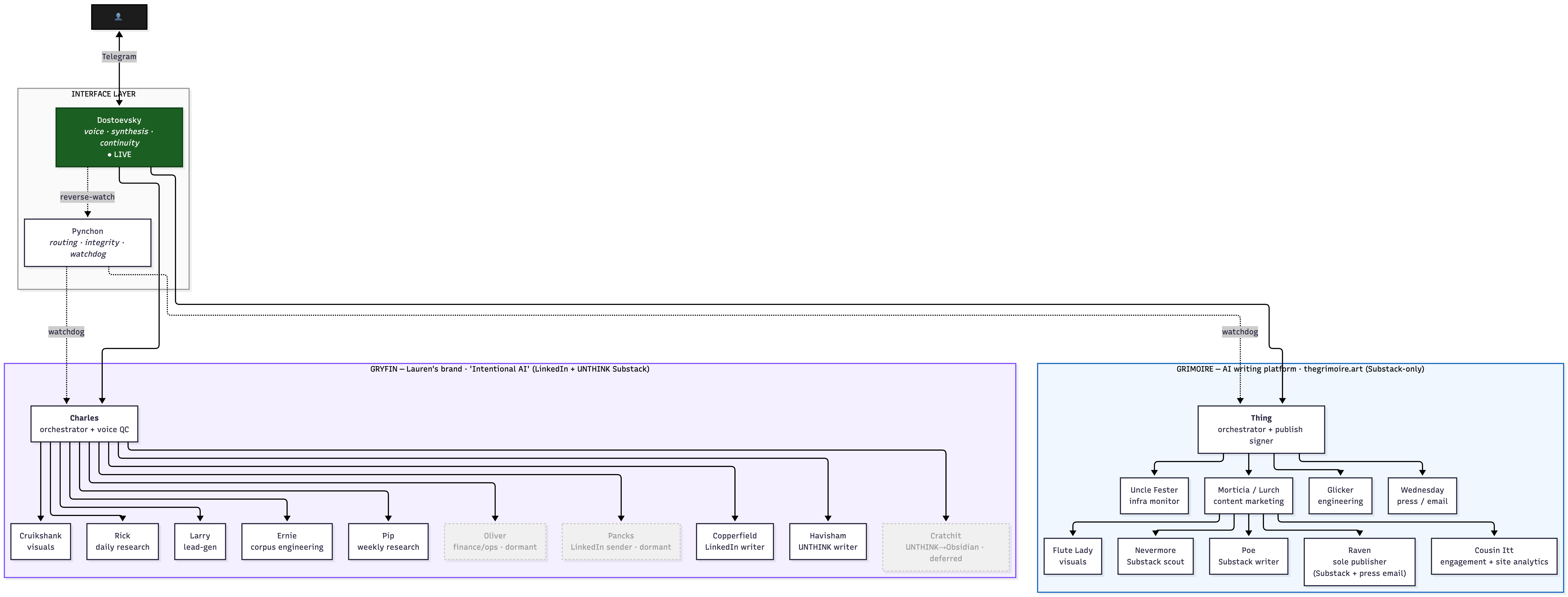
The name is on purpose. Yes, I named it after the Ayn Rand novel that promotes individualism, enlightened self-interest, and creative integrity — but the older meaning of the word is doing real work too. The source. The place where the water starts. Every business I run flows from one system.
The Fountainhead is an autonomous operating system. It runs on a Mac mini in the part of my house my wife calls my “man cave.”
I am still waiting to one day build a garden shed like Mike - The AI Grandad . For now, the man cave does the job.
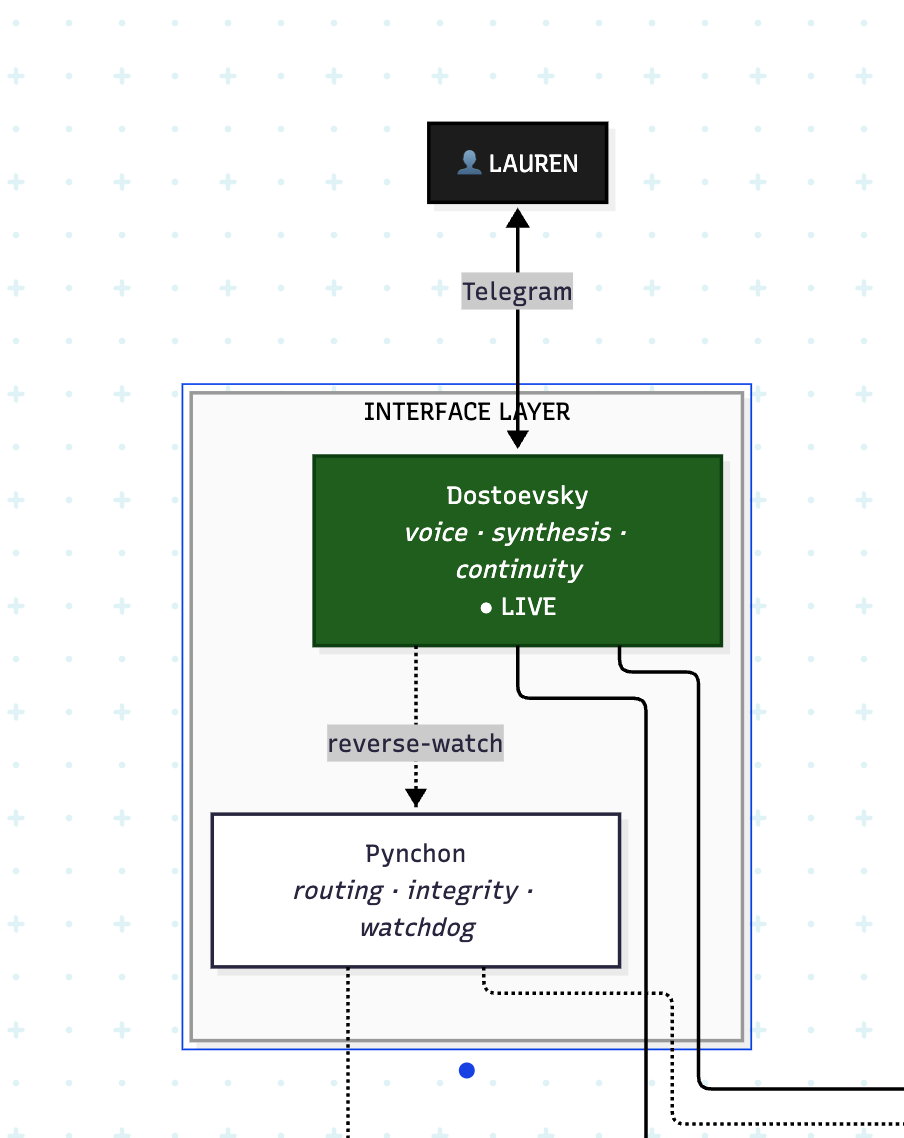
Anyway, the system has four layers. The layers are the entire point, so I am going to walk you through them.
P.S. Next week I will go deeper into the intentional naming and personas assigned to the agents that make up each of these layers. For now, I just want to outline the structure, or else this would turn into a 45-minute read.
Layer one: me.
I talk to one agent. I built a multi-agent system in which the human only ever has one conversation. Everything else cascades from there. If you remember nothing else about this piece, remember that. The point of autonomy is not to talk to more things. It is to talk to fewer.
Now this does not mean the other agents in the system don’t know me, they do. Through user.md files and interactions I have with the agent I interface with. We just don’t have direct contact.
I talk to the system through Telegram. From my phone. From bed, from the trail, from the couch on a Sunday night. It is the most human interface I could think of — a chat thread with one entity who knows me and who routes everything else.
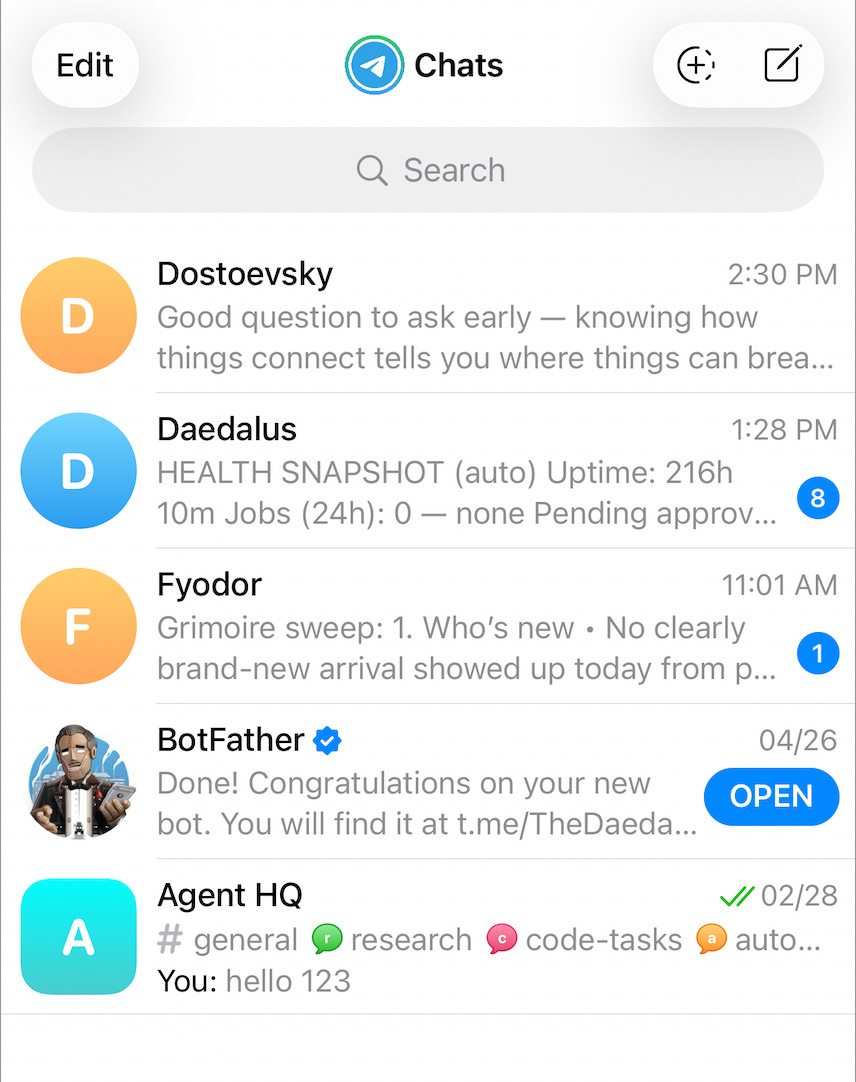
Layer two: the interface.
Two agents whose only job is to hold the experience of the system. They sit parallel to one-another. One faces up toward me via Telegram to have conversations, give updates, etc. The other faces down toward the machinery and handles routing and integrity. He is the watchdog that makes sure the system stays runs.
They also watch each other (more on this next week).
Most autonomous systems collapse the interface and the engine into one agent. I separated them on purpose, because the person you are talking to should not also be the person running the plumbing. That is true in human organizations and it is true here. The simpler the task and the clearer the scope of work the better the outcome.
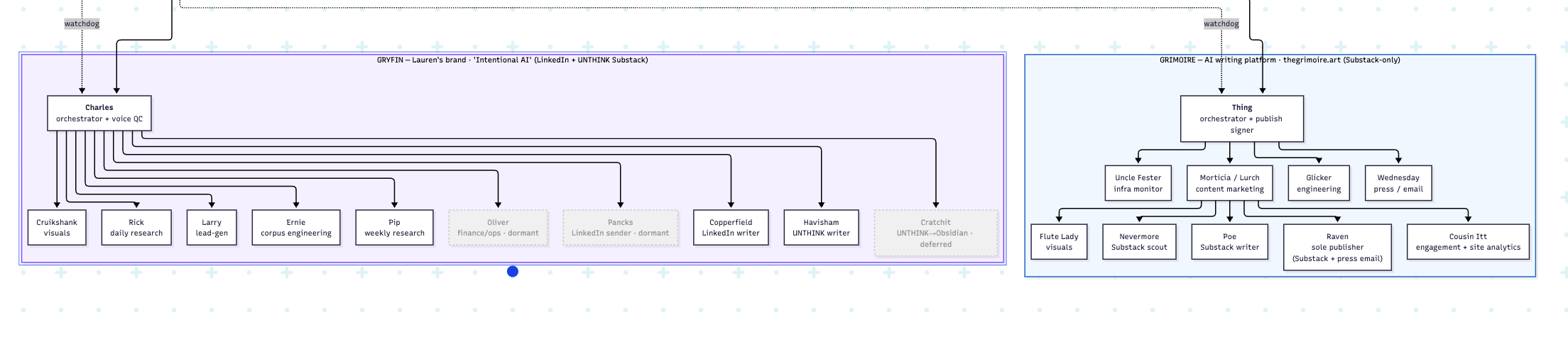
Layer three: the domain orchestrators.
I have one domain orchestrator per business.
Right now two businesses are plugged into the system: Grimoire and Gryfin.
Each domain orchestrator functions as the CEO of their domain, they are the brain of the business they oversee. They hold the brand standards, the publishing approvals, the QC, etc. They manage their own teams and they have full autonomy to make the final decision. They report up to layer two.
Layer four: the specialists.
The specialists do the work. They write. They research. They handle graphics and visual design and lead-gen. Each AI has one job and specific scaffolds in place to make sure they do their job well.
What this is for
The point of the Fountainhead is not to remove me. It is to expand me.
It is to reduce friction-points to allow me to accomplish more than I ever could on my own.
The work is the thinking. The work is the choosing. The work is the voice.
The system protects all three.
This positioning is intentional.
The dominant story right now is: automate everything and become a millionaire while you sleep. That story is fun to think about but it is not entirely interesting to me. I do not want to sleep through my own life. I want to be more awake inside it, inside my creations. I want the things I make to feel more like me, not less. I want my businesses to sound like I created them intentionally, because I did, even when I didn’t type every single word.
The Fountainhead is the architecture that makes that possible.
Why I am writing this
Because someone is going to read this and recognize their own Sunday night.
You don’t need my architecture. You just need to believe that yours is possible. The leap is not technical. The leap is the moment you stop seeing your ideas as a list of things you have failed to do, and start seeing them as pieces you can mold together.
Organizations have always been the answer to the problem of being one person with more ambition than hours. Now, Pluto is sitting in Aquarius, and showing us all that there is another way. We can build our own organizations with AI in the comfort of our homes.
All you need is the willingness to take your own ideas seriously enough to name them, some curiosity, and the desire to start.
What’s next
Part 2 next week is the technical build — the naming, the Claude Agent SDK, the memory architecture, the signing keys, the watchdogs, the protocols that keep everything from collapsing into noise. How Dostoevsky and Pynchon actually watch each other. Why every Grimoire publish is cryptographically signed. Basically all of the really nerdy plumbing that makes me giddier than I can say.
Part 3 comes out the following week and my goal is to share the outcomes so far— the good and the bad. It will include: what I would do differently if I started over, how you can build your version of this without spending a year figuring out which mistakes were the expensive ones.
As you read through this series keep in mind that the system is still being built. For all I know, some of what I wrote down here will be wrong or changed by the next time I publish. We are living in new times. Every day and every build is a new moving target. I am fine with that. I will move and learn with it.
I hope you will too.
…I now know my weekend plans. 😂😂
The overlap between what you’re building and questions I’ve been wrestling with is startling—in an electrifying way. Especially the idea that AI might let us stop narrowing and start being.
Excited to follow along.
Hey Lauren — "the point of autonomy is not to talk to more things — it is to talk to fewer" is the design insight most people building agent systems get exactly backwards. Everyone adds agents. Almost nobody asks which conversations to eliminate.
I build custom AI agents and the four-layer architecture is smart — especially the single Telegram interface. Most multipassionate founders I work with drown not because they lack capability but because they lack a single pane of glass. Eleven businesses through one conversation is a fundamentally different cognitive load than eleven dashboards.
The bottleneck was never the work. It was the context switching.
The part I'd push on: "the work is the thinking, the choosing, the voice — the system protects all three." That's beautiful as a principle. The hard part is when the system starts subtly shaping the thinking and choosing because it optimizes for throughput. Twenty-four agents have their own gravity. They'll pull toward efficiency even when what you need is to sit with an idea for three days before it's ready. The system that protects your voice needs a kill switch for when the system itself becomes the noise.
Curious how you're handling agent drift across 24 personalities — do they stay in character over weeks or do you find yourself recalibrating?